
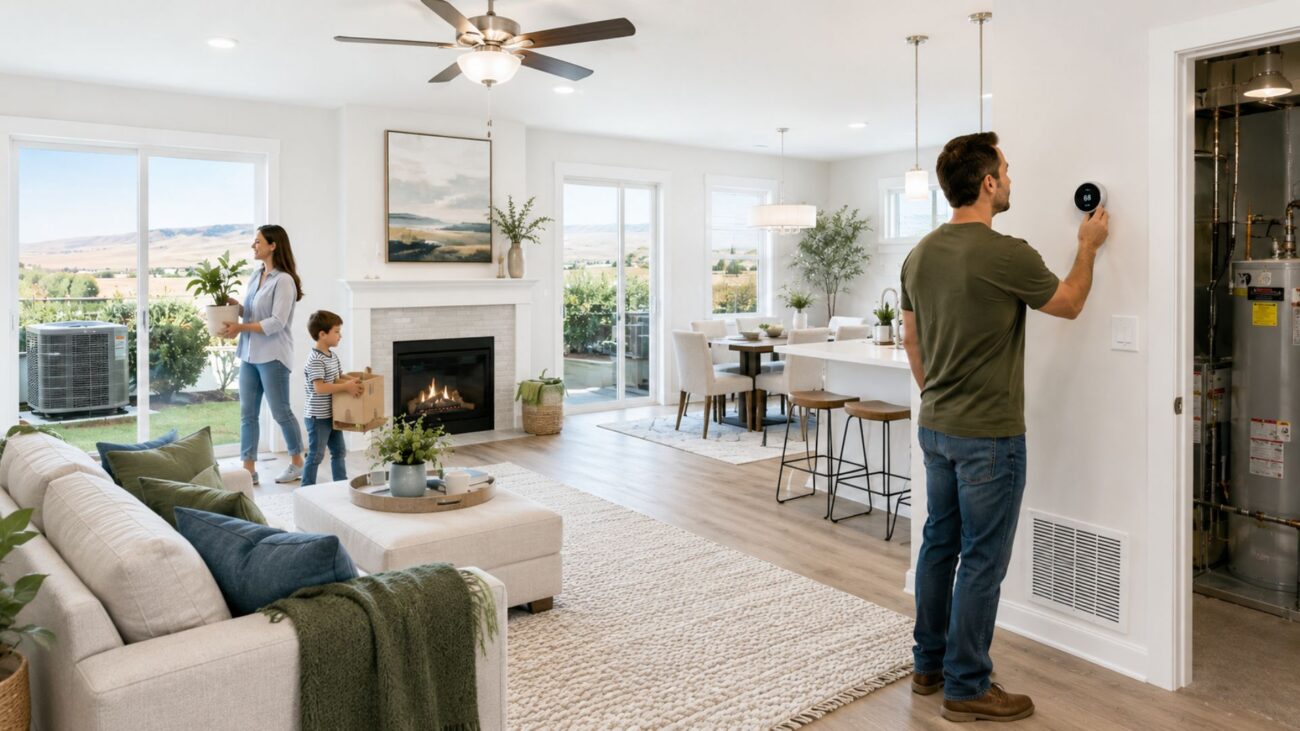
You got the keys. The boxes are inside. The Wi-Fi is connected.
And somewhere between deciding where the couch goes and wondering why you own 14 boxes labeled “miscellaneous,” there’s one question that tends to get overlooked:
Is the house actually ready to keep you comfortable?
Moving into a new home in Pasco, Kennewick, Richland, or elsewhere in the Tri-Cities is exciting. But a house can look perfect during a walkthrough and still have comfort issues hiding behind walls, above ceilings, underneath floors, or inside equipment you haven’t thought about yet.
Maybe one bedroom never seems to cool down.
Maybe the thermostat says everything is fine, but the house disagrees.
Maybe there’s a draft you didn’t notice until your first quiet evening at home.
That’s why your first home checklist shouldn’t stop at changing the locks and locating the breaker panel.
Here are 8 comfort systems and areas worth checking when you move into a Tri-Cities home.
1. Start With the Thermostat
It’s one of the smallest devices in your house, and one of the first places you’ll notice when your comfort feels off.
Total Quality Air installs thermostats along with furnaces, air conditioners, heat pumps, fireplaces, and other residential comfort equipment.
When you move in, spend a little time getting familiar with yours.
Ask yourself:
- Is it easy to operate?
- Does the temperature shown seem consistent with how the house actually feels?
- Do you understand its schedules and settings?
- Are you constantly changing it because certain rooms never feel right?
And remember: the thermostat isn’t always the problem.
If the thermostat says 72° while one bedroom feels like it has entered a completely different climate zone, airflow, ductwork, or another part of the comfort system may need attention.
New homeowner reality:
The thermostat controls the temperature.
It does not control the family debate about what the temperature should be.
2. Get Familiar With the Heating and Cooling Equipment
Before the first truly hot or cold Tri-Cities day catches you by surprise, figure out what is actually keeping your home comfortable.
Your home may rely on an air conditioner, furnace, heat pump, or another comfort-system configuration. Total Quality Air services and repairs a wide variety of HVAC equipment and works on all brands and models.
You don’t need to become an HVAC technician overnight.
But you should know:
- Where the equipment is located
- What type of system you have
- Whether the home heats and cools evenly
- Whether you notice weak airflow or unusual operation
- Who to call if the system needs professional attention
TQA’s approach is to assess the homeowner’s needs and recommend the solution they believe will make the system more efficient rather than simply treating every home exactly the same.
Because your first introduction to your HVAC system should ideally be:
“Oh, that’s where it is.”
Not:
“WHY IS IT MAKING THAT SOUND?”
3. Check the Ductwork, Because Comfort Can Disappear Before It Reaches the Room
Here’s something homeowners don’t always think about:
Your heating and cooling equipment can produce conditioned air correctly, but that air still has to travel through the duct system to reach the rooms in your house.
Total Quality Air notes that leaks, holes, disconnected ducts, poorly sealed registers, leaks around furnace or filter areas, and kinks in flexible ductwork can all contribute to airflow problems.
According to TQA, typical houses can lose about 20% of the air moving through the duct system because of leaks, holes, and poorly connected ducts.
That can show up in everyday life as:
- One room running warmer than another
- Rooms that never seem comfortable
- Drafts
- Higher heating or cooling costs
- A system that seems to work harder than expected
So before assuming the equipment itself needs replacing, remember:
Sometimes the problem isn’t making the air.
It’s getting the air where it’s supposed to go.
4. Look Beyond the Equipment for Hidden Air Leaks
Not every comfort problem lives inside an HVAC unit.
Your home’s exterior walls, ceiling, windows, and floor make up what TQA describes as the home’s “envelope” or “shell.” Air leaks around this envelope can affect both comfort and energy use.
Some leaks are obvious.
You feel a draft around a door and immediately think:
Well, that’s not ideal.
Others can hide in attics, basements, and crawlspaces. TQA uses diagnostic tools to help identify hidden air leaks in homes.
TQA also notes that properly sealing and insulating the home envelope can potentially reduce heating and cooling costs while helping the home’s comfort system operate more efficiently.
So if your new house feels drafty even though the HVAC system appears to be running normally, the next question may be:
“Where is our conditioned air escaping?”
5. Don’t Forget Ductless Systems
Some homes rely on, or include, ductless comfort equipment.
If your new Tri-Cities home has a ductless system, take time to understand how it operates instead of assuming it works exactly like the system in your previous home.
Total Quality Air specializes in heating and cooling solutions throughout the Tri-Cities and can assess a home’s specific comfort needs rather than simply installing equipment that “works.” The company’s stated goal is a system homeowners are actually happy and comfortable with.
Pay particular attention to whether the areas served by the system are consistently comfortable.
Your first week in the house is a great time to notice patterns:
Does one part of the home feel great while another never quite catches up?
That observation can be useful if you later have the system professionally evaluated.
6. Check the Water Heater Before the First “Surprise” Shower
Heating and cooling usually get all the attention when people talk about home comfort.
Until there is no hot water.
Then suddenly, the water heater becomes the most important appliance you own.
Total Quality Air services, repairs, maintains, and installs both gas and electric water heaters.
When you move in, find out:
- Where the water heater is located
- Whether it is gas or electric
- Whether hot water is consistently available
- Whether anything about its operation concerns you
Because there are few experiences that introduce you to a new house faster than discovering the hot-water situation at 6:47 on a Monday morning.
Know what you have before you need it.
7. Know Where Gas Piping Fits Into Your Home
Does the home have, or are you planning to add, a gas fireplace?
A gas water heater?
A gas oven?
An outdoor BBQ?
A fire pit?
Those lifestyle upgrades all have one less-glamorous component behind them:
the gas line.
Total Quality Air professionally installs both natural-gas and propane gas lines for applications including BBQs, gas water heaters, gas ovens, gas fireplaces, and fire pits.
This becomes especially important if moving into the home also means planning future upgrades.
That Pinterest-worthy backyard fire pit?
Fantastic.
But before choosing the chairs and string lights, make sure the infrastructure behind the idea is part of the plan too.
8. Find Out How the System Has Been Maintained, and Make a Plan Going Forward
A house isn’t just something you buy.
It’s something you maintain.
Total Quality Air emphasizes preventive HVAC maintenance as a way to support peace of mind, long-term savings, and trouble-free operation, while helping reduce the chance of costly emergency service calls.
TQA’s maintenance program includes two HVAC system inspections per year, priority service, no overtime rates for after-hours or weekend calls for enrolled maintenance customers, and other listed program benefits.
For a new homeowner, the bigger lesson is simple:
Don’t wait until something stops working to start thinking about it.
Once you’re settled in, create a maintenance plan for the equipment that keeps the home comfortable.
Future-you, especially future-you during an extremely inconvenient breakdown—may appreciate the effort.
Your House Passed the Inspection. Now Make Sure It Passes the “Living Here” Test.
A home inspection tells you a lot.
But actually living in the house reveals different things.
You discover which bedroom gets warmer.
Where the draft shows up.
How the airflow feels.
Whether the hot water keeps up.
How the thermostat behaves.
And whether the house that looked comfortable during the showing actually feels comfortable once you’re living your normal life inside it.
That’s the difference between a house full of equipment and a home with a comfort system that works together.
Total Quality Air serves homeowners and businesses throughout Pasco, Kennewick, Richland, and the Tri-Cities, providing installation, maintenance, service, and repair for heating and cooling systems along with additional home-comfort services.
If you’ve recently moved into a Tri-Cities home and aren’t sure what condition your comfort system is in, you don’t have to guess.
Start by getting to know your home.
And when something doesn’t feel right, have it checked before a small comfort problem becomes the reason your new house suddenly feels a lot less relaxing.
Need Help Understanding Your New Home’s Comfort System?
Total Quality Air provides residential HVAC service, repair, maintenance, and installation throughout the Tri-Cities.
Call Total Quality Air: (509) 205-1592
Serving Pasco, Kennewick, Richland, and the Tri-Cities
Hablamos Español
Total Quality is not just our name, it is our promise.
